A Look at Kamino’s RWA Yield Markets

Disclaimer
This report is made in collaboration with Kamino and is therefore sponsored. All editorial decisions, opinions and conclusions are our own and remain independent of any external influence.
Introduction
Kamino continues to expand its suite of non-crypto yield products, with several of these now offering yields above 20% APY. In today's report we look at three strategies currently live on the protocol and how the recent introduction of fixed borrow rates changes the risk/reward for Multiply users.
Auto
AUTO is Kamino's latest addition to its suite of non-crypto yield-bearing assets. In short, AUTO is a token from Hastra that gives holders exposure to a pool of U.S. consumer auto loans. Users stake wYLDS, Figure’s yield-bearing stablecoin, into AUTO, with the capital then lent into the auto loan pool on Figure’s “Democratized Prime” marketplace.
AUTO has delivered an average APY of 8.37% over the past 3 months from interest on these loans. Looping AUTO through Kamino Multiply offers a significantly higher return and can be done with either a variable or fixed borrow rate.
Variable borrow rates (USDC and pyUSD)
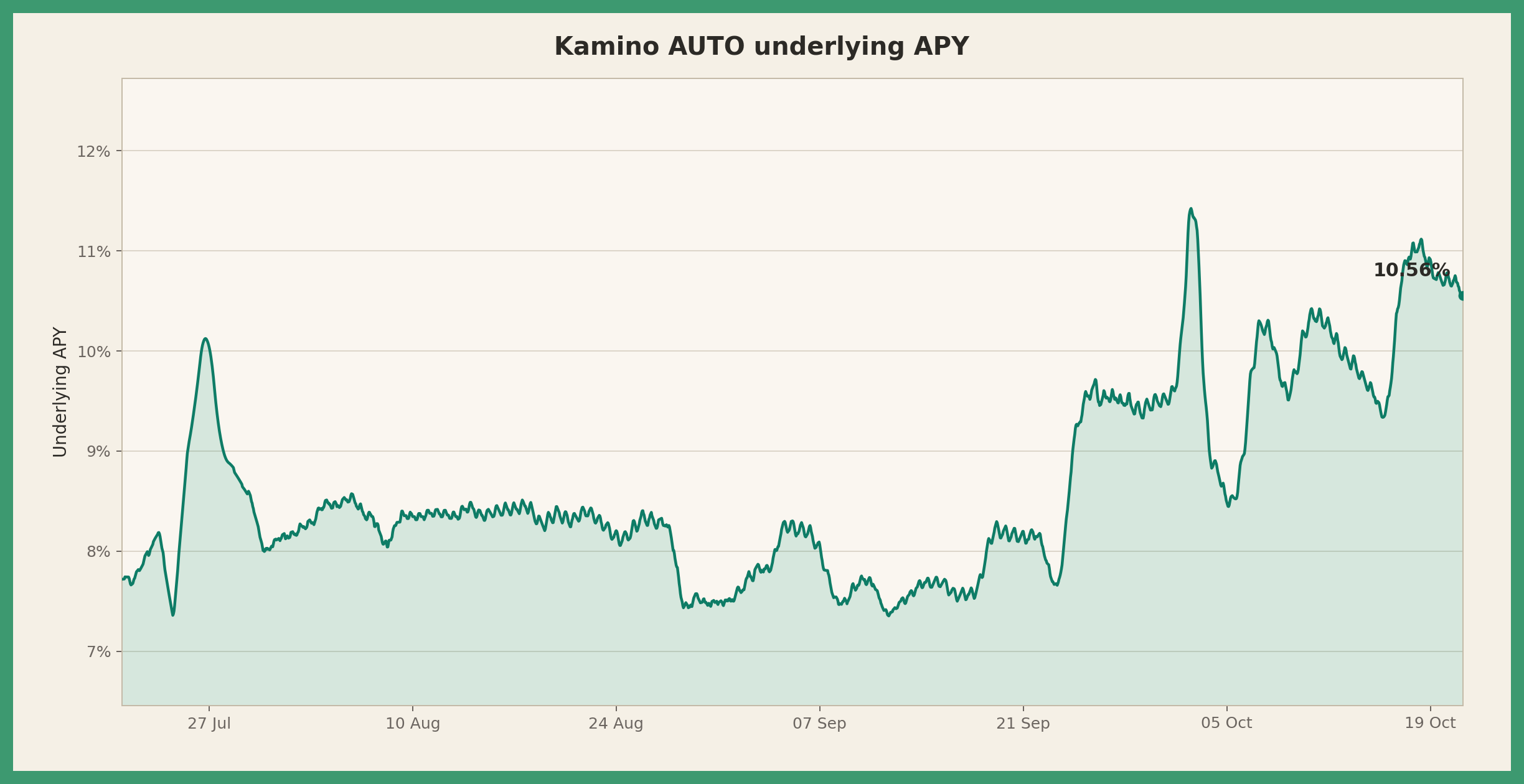
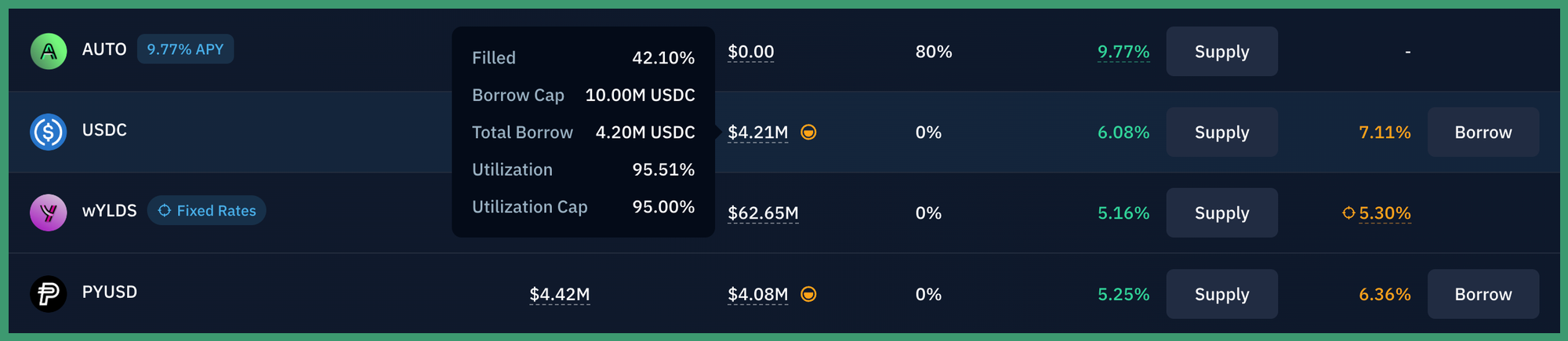
On the AUTO market, users can borrow either USDC, pyUSD or wYLDS against AUTO. USDC and pyUSD are borrowable in the standard way with a variable borrow rate, which fluctuates as a function of the utilization rate. As more of the available USDC and pyUSD gets borrowed, the cost increases, thus reducing the overall yield on the Multiply loop. A large new borrow can therefore push up utilization and spike the borrow cost, which historically has been one of the main concerns with these sorts of looping strategies.
Kamino mitigates this by having utilization caps for both USDC and pyUSD:
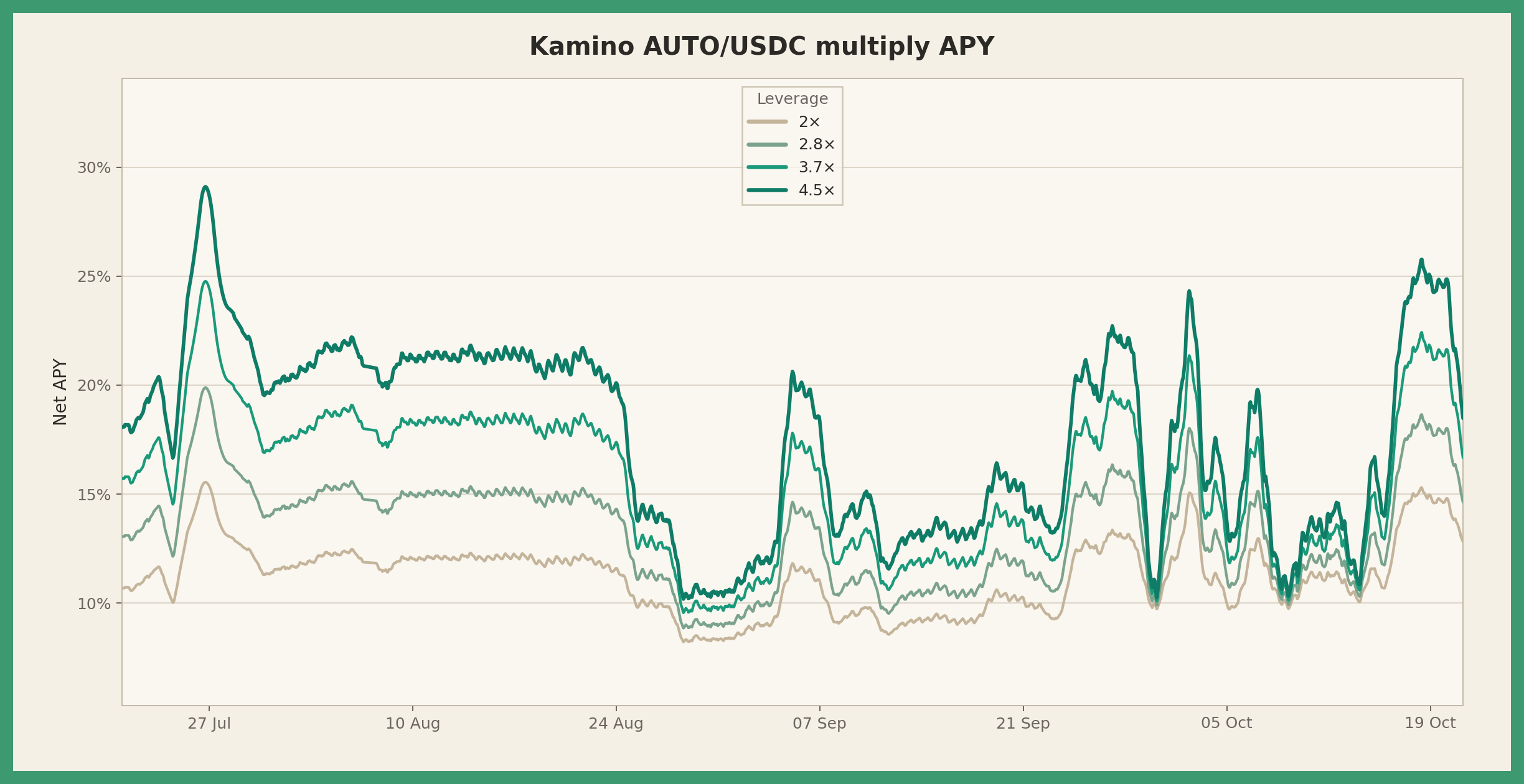
The figure below shows the multiply APY over the past 3 months at different levels of leverage for pyUSD and USDC borrowed against AUTO.
Fixed borrow rates
Earlier this year, Kamino introduced fixed borrow rate markets. This is attractive to Multiply users as it eliminates the risk of borrow rates spiking and gives a much steadier return that is primarily dependent on the yield of the collateral asset itself, AUTO in this case.
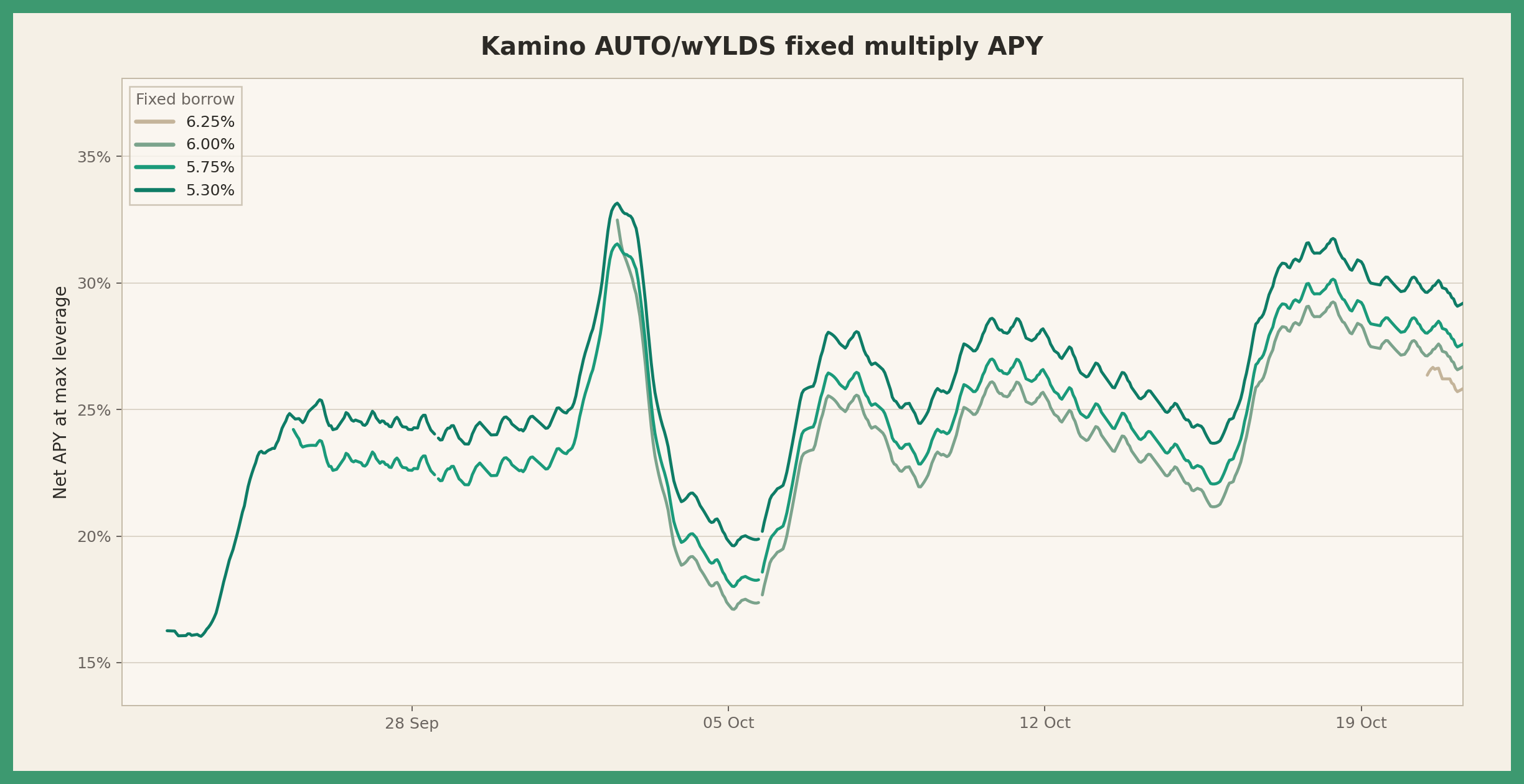
So far, Kamino has introduced four 1-month fixed-rate tranches on the AUTO market at annual borrow rates of 5.3%, 5.75%, 6% and 6.3%. The figure below shows the APY at max leverage over the past month for each of these tranches.
These are all at max capacity with no remaining liquidity, but we’ve been told new markets are coming soon, so keep an eye on announcements from the Kamino X profile if you’re looking to deposit.
What happens at the expiry of a fixed-term borrow market? In short, the position is rolled over into a new fixed term at the same or a lower borrow cost. If that isn’t available, it switches to the variable borrow rate or ultimately winds down the position.
Currently, there is enough liquidity for most of the positions to be rolled over. For full details, check out the post by Kamino Intern below:
day 1 AUTO/wYLDS loopers, your loans are already starting to roll over.
— Kamino Intern (@kaminointern) October 19, 2026
here's how Auto-Rollover works:
> you initially borrow at a fixed rate for 30 days.
> after 27 days, your position enters the rollover window.
> @kamino automatically tries to refinance your loan into a new… pic.twitter.com/Pk0oA3uyXu
Risks & Exposure
The main risk when exposed to AUTO is related to credit risk on the underlying consumer auto loans. The pool is made up of near-prime and subprime borrowers and Figure estimates a ~9.9% forward 12-month loss rate. The underlying auto loans generate roughly 20% in net interest, while AUTO holders earn around 9%, leaving a large buffer to absorb credit losses before depositors are impacted. There is also a 2.5% reserve account and a $25m Figure seed commitment as initial seeding and acting as first-loss capital.
2) OnRe
Longtime Kamino users are undoubtedly familiar with OnRe given how long it has offered high yield that is uncorrelated with crypto. As a quick recap, OnRe is an onchain reinsurance company on Solana, with ONyc being its main yield-bearing product.
Deposits into ONyc are used to collateralize short-duration reinsurance contracts and earn the insurance premiums from these. Roughly half of ONyc’s $282m AUM is deployed into reinsurance contracts, with the rest held in the liquidity layer (USDG), T-bills and yield-bearing stablecoins. You can find the complete allocation here.
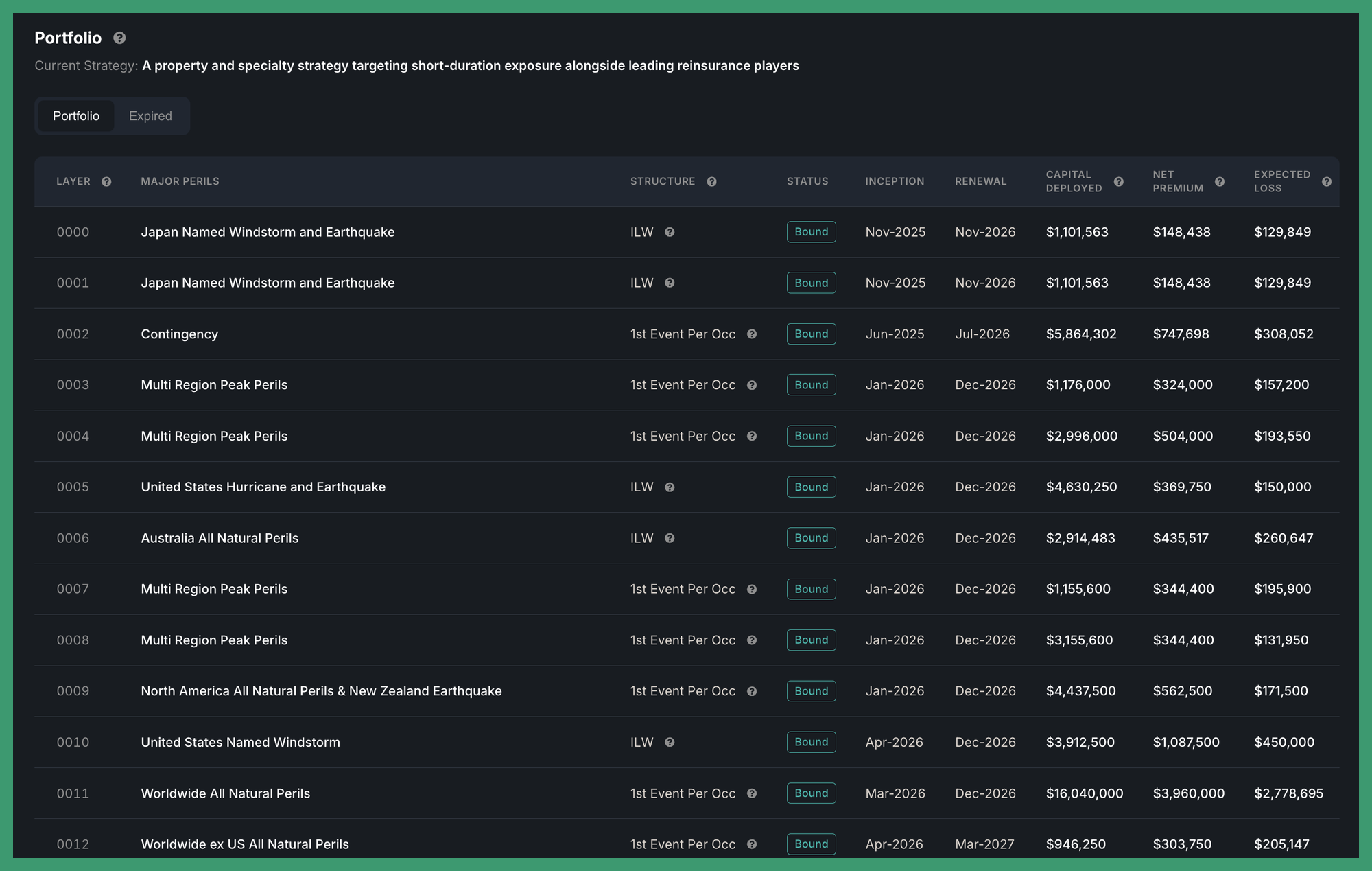
ONyc currently yields ~11% APY, with an average year-to-date APY of 11.02%.
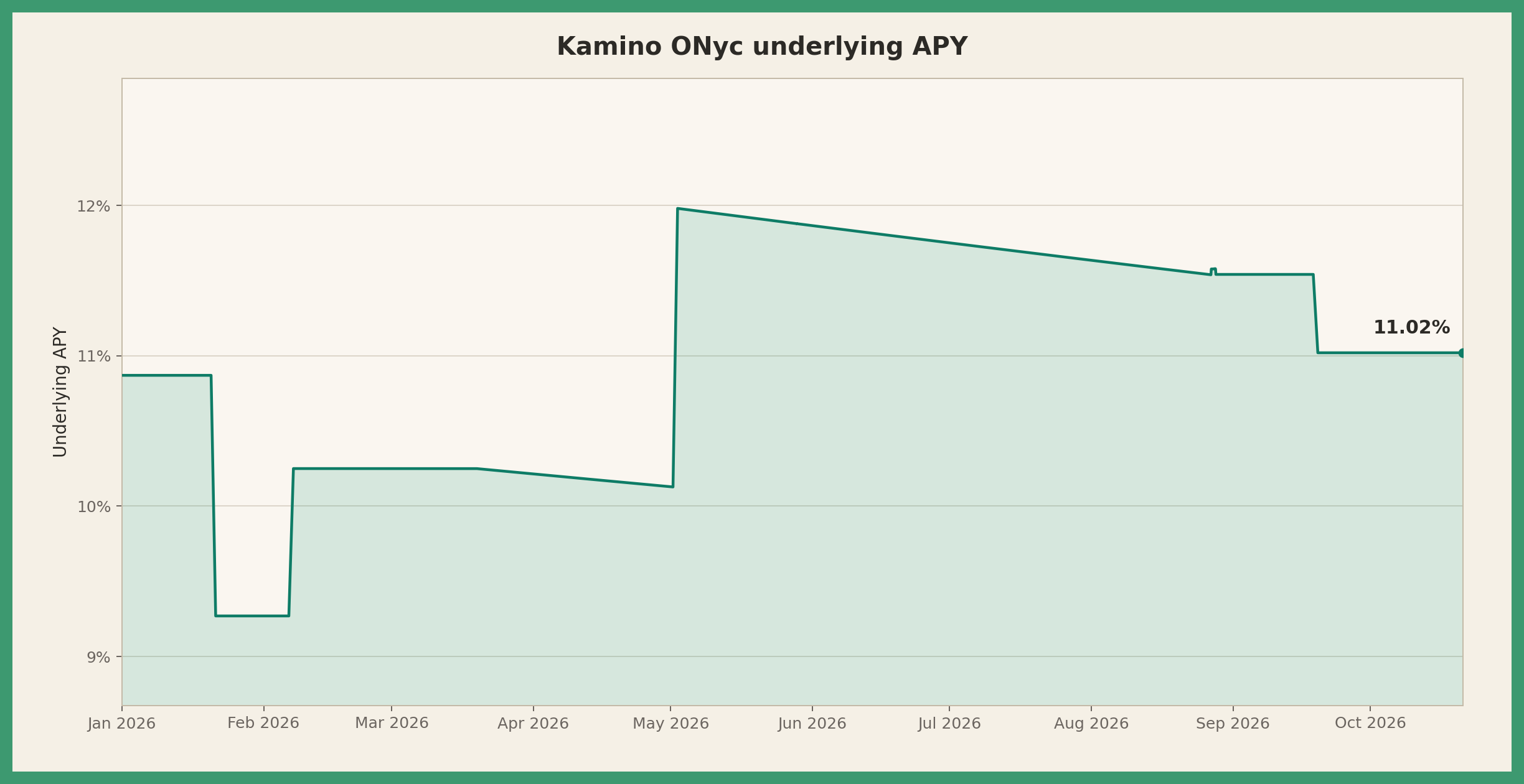
OnRe has become deeply integrated across Solana DeFi, with most of its supply deployed across protocols like Kamino, Loopscale and Exponent. ONyc has been live on Kamino for over a year, and the ONyc Multiply strategy has arguably been one of the best yield sources on both Kamino and Solana more broadly throughout this period.
Year-to-date, ONyc Multiply has delivered an 18% APY at 2.9x leverage (max), 16% at 2.5x and 14% at 2x. With a market size of >$250m and ~$5m of liquidity available at the time of writing, the strategy can also be entered with decent size.
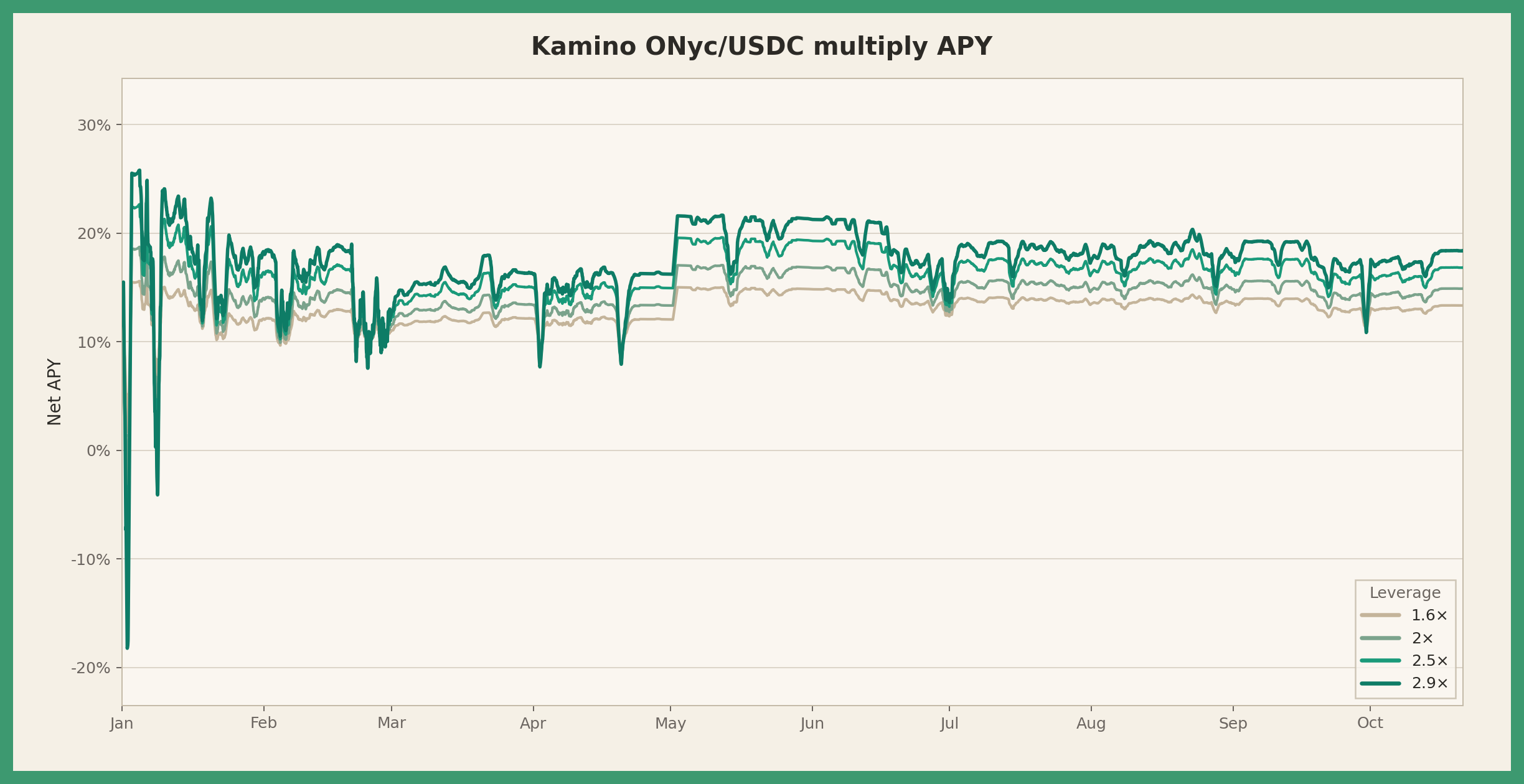
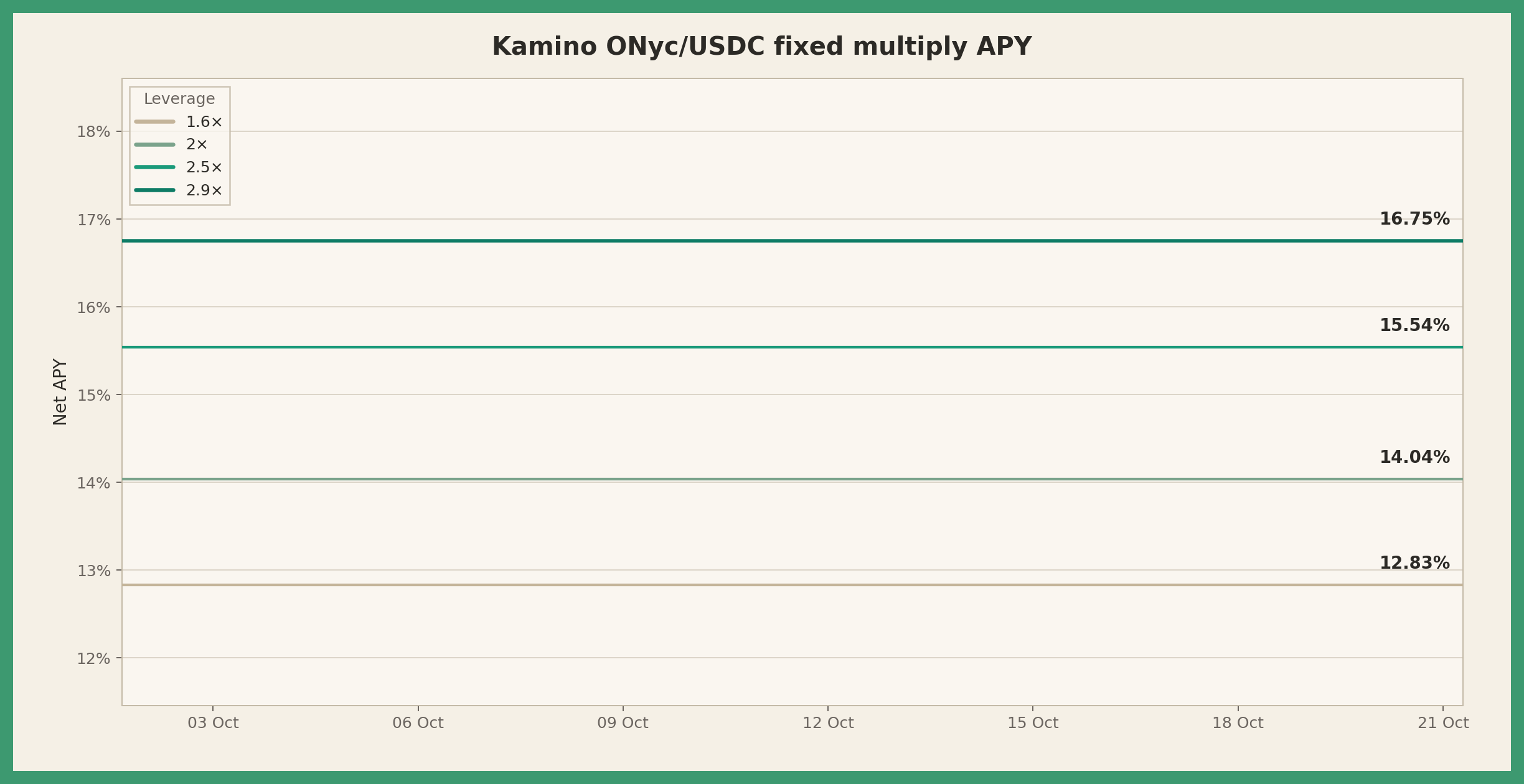
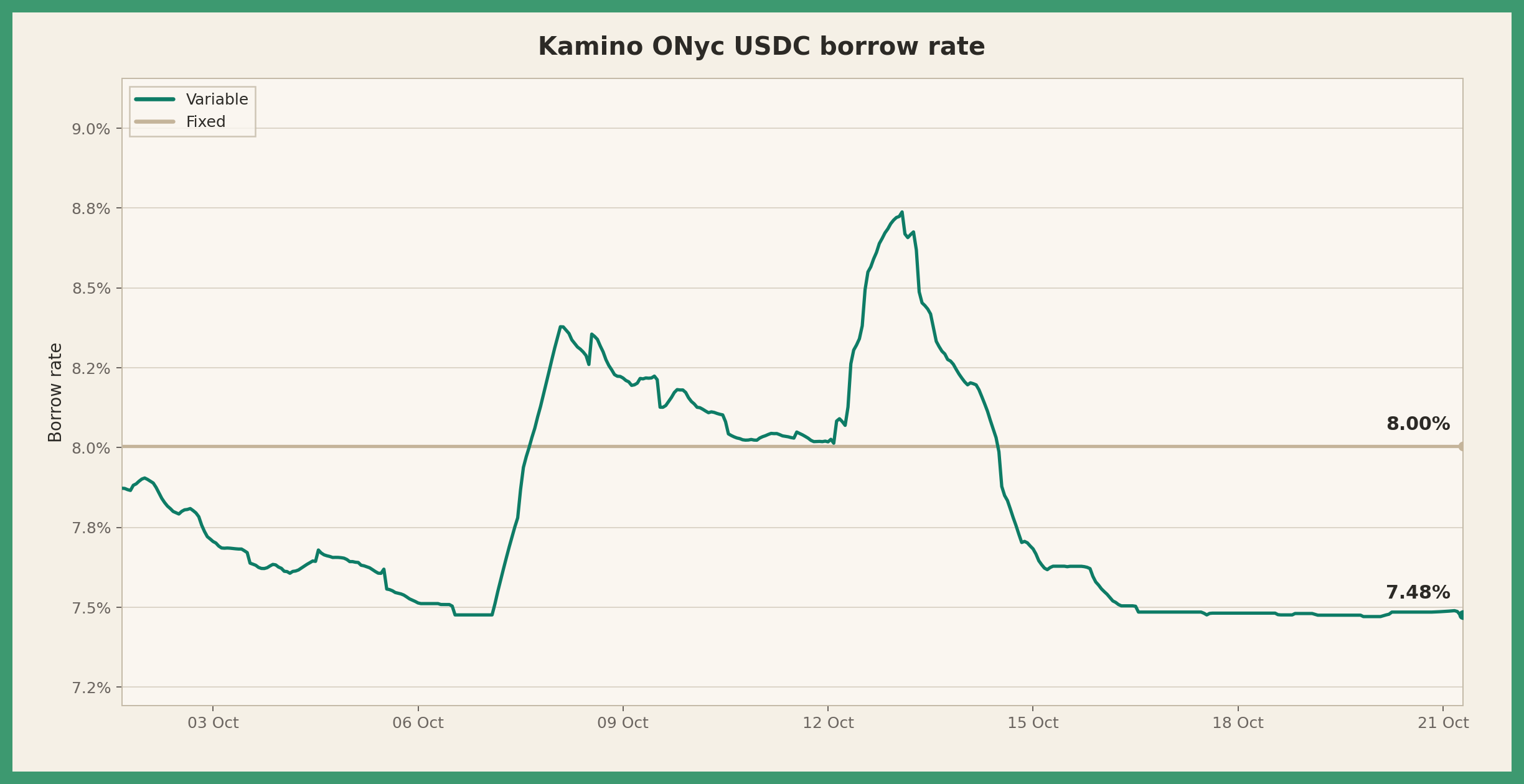
A new fixed borrow market opened recently, offering the same high yield without the risk of the borrow rate spiking as large amounts of new capital enter the strategy. On this Multiply loop, users borrow USDC at a fixed 8% APY for a 30-day term, which nets a 16.75% APY at the max 2.9x leverage.
The figure below shows the fixed versus variable borrow rate over the past month.
Risks & Exposure
When it comes to liquidation risk on this Multiply strategy, Kamino doesn’t use the AMM price for ONyc, which can at times be volatile and illiquid. Instead, the oracle is NAV-referenced and looks at the underlying value per ONyc, with the reinsurance portfolio value recalculated daily and published through Chainlink and Pyth. At 2.9x leverage, you can sustain a ~12% drawdown in NAV before partial liquidations kick in and generally don’t have to worry about fluctuations in the AMM price of ONyc.
Aside from this, holders of ONyc are ultimately taking reinsurance risk. If claims exceed the reserves and premiums set aside for them, ONyc NAV can decline. This makes the yield quite different from most crypto-native yield products as the return is primarily driven by insurance underwriting.
OnRe also keeps a share of the premium/yield as a buffer against expected losses. More on this here.
3) Commodity Vault
A final reliable yield strategy that is also uncorrelated with crypto prices and sentiment is the commodity vault on Kamino. TVL in the vault has grown to $50m and it currently offers an APY of over 8%.
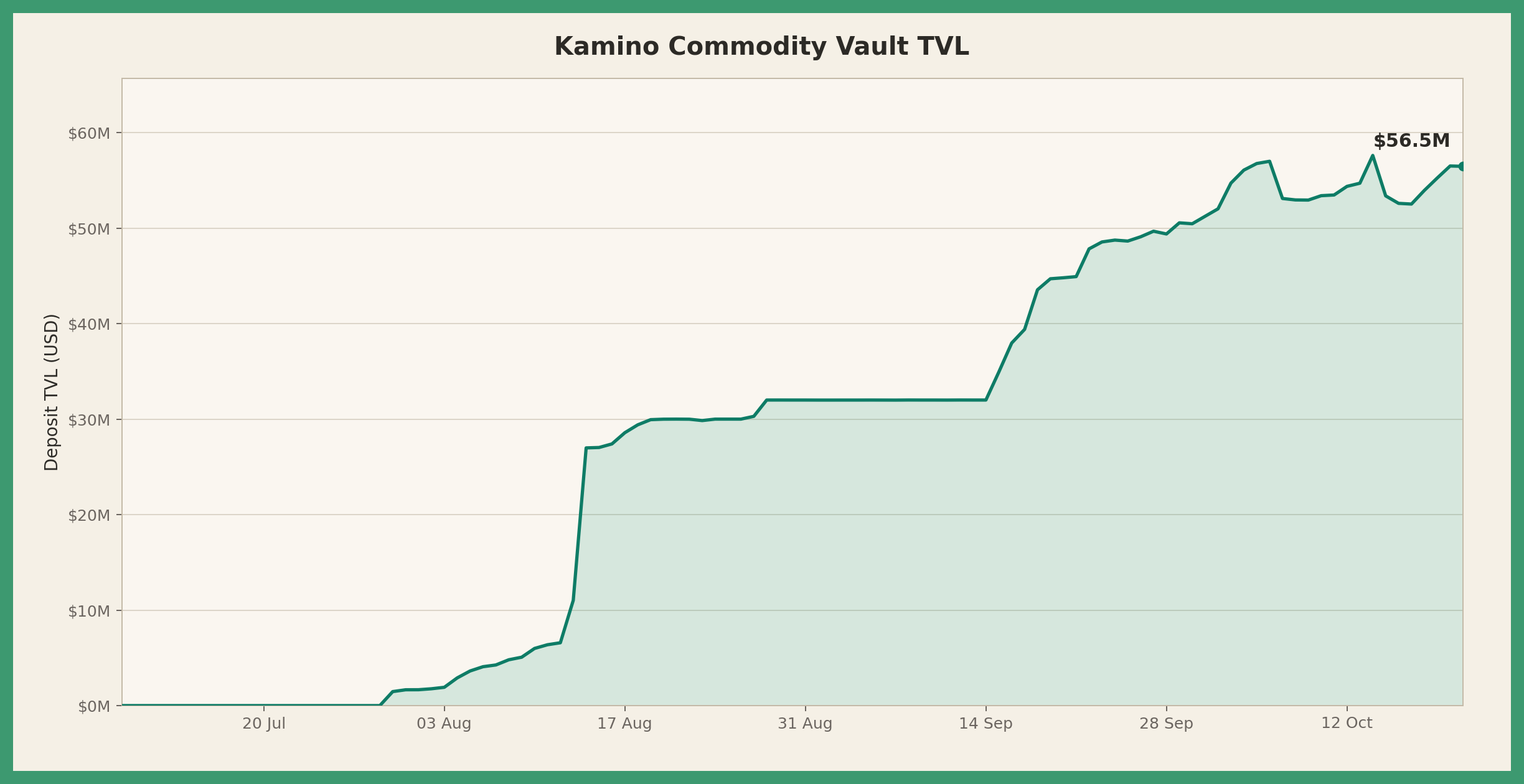
The strategy, simply laid out, lends USDC to commodity traders against physical commodity collateral, with the interest on these loans generating the yield for depositors. Of the $56m in TVL, $48m is currently lent out across two loans and backed by $48.63m in collateral. All the parameters of the strategy can be found here. You can also check out our most recent report, which covered this strategy in depth:
 hyphin

The information provided is for general informational purposes only and does not constitute financial, investment, or legal advice. The content is based on sources believed to be reliable, but its accuracy, completeness, and timeliness cannot be guaranteed. Any reliance you place on the information in this document is at your own risk. On Chain Times may contain forward-looking statements that involve risks and uncertainties. Actual results may differ materially from those expressed or implied in such statements. The authors may or may not own positions in the assets or securities mentioned herein. They reserve the right to buy or sell any asset or security discussed at any time without notice. It is essential to consult with a qualified financial advisor or other professional to understand the risks and suitability of any investment decisions you may make. You are solely responsible for conducting your research and due diligence before making any investment choices. Past performance is not indicative of future results. The authors disclaim any liability for any direct, indirect, or consequential loss or damage arising from the use of this document or its content. By accessing On Chain Times, you agree to the terms of this disclaimer.