Aggregating the Real World - An Interview with Variational

Introduction
Over the past year, RWA perps have become one of the most exciting verticals in crypto. While most venues are racing to list more markets and build deep orderbooks, Variational is taking a different route: a brokerage-like model that aggregates liquidity and offers zero-fee trading through its Omni product. Variational aims to connect traders directly to existing liquidity sources across CEXs, DEXs, OTC desks and, eventually, TradFi dealers.
We had a chat with Max from Variational to better understand the exchange’s design, its focus on RWA markets, the Omni Liquidity Provider, the points program, and what the next phases of its roadmap could look like.
If you enjoy this type of content make sure to subscribe below.
Growth & Metrics
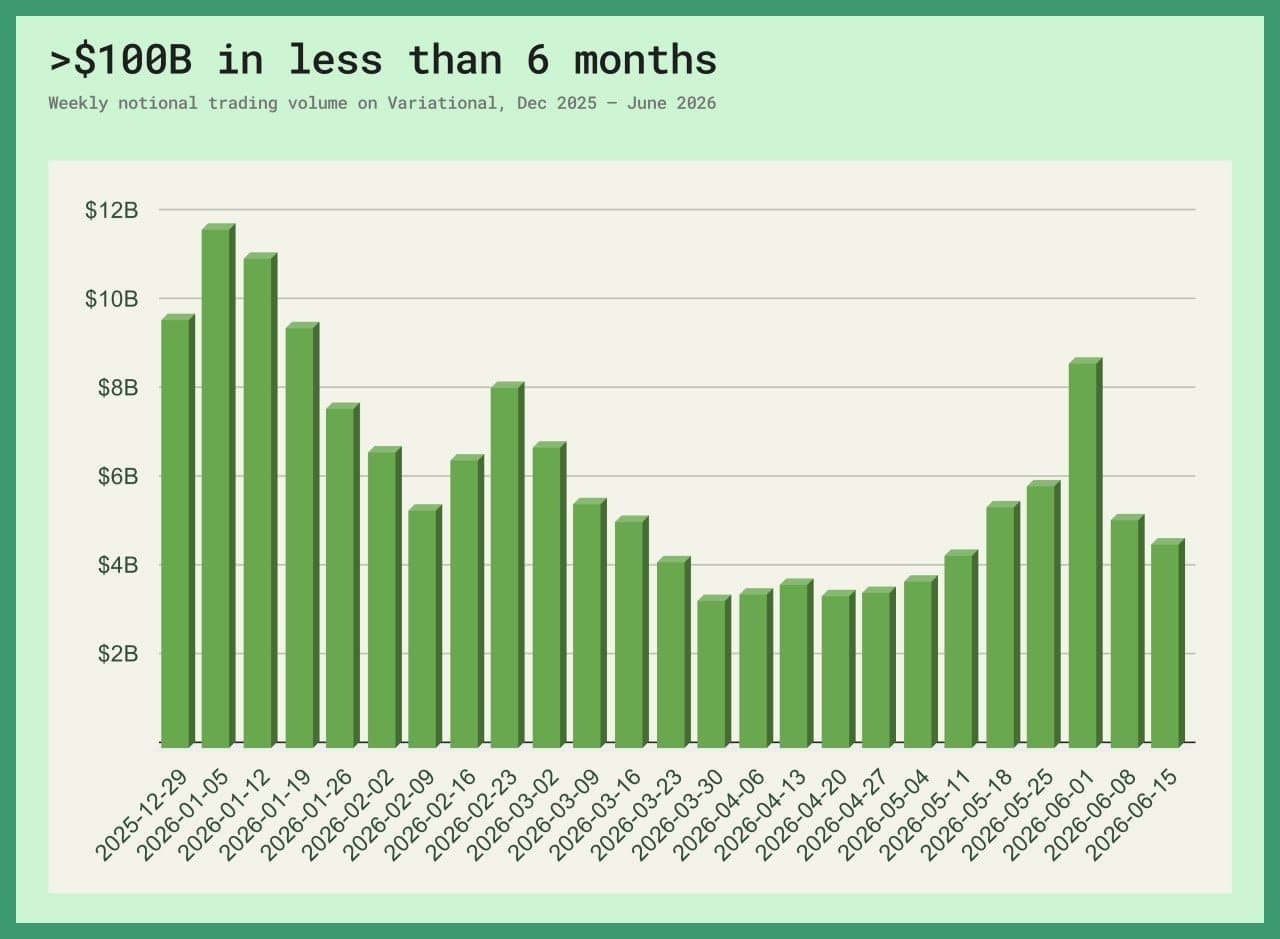
This year, Variational has become one of the largest perp venues in both trading volume and open interest. Since launching its points program in December, the exchange has processed more than $100B in notional trading volume in less than 6 months.
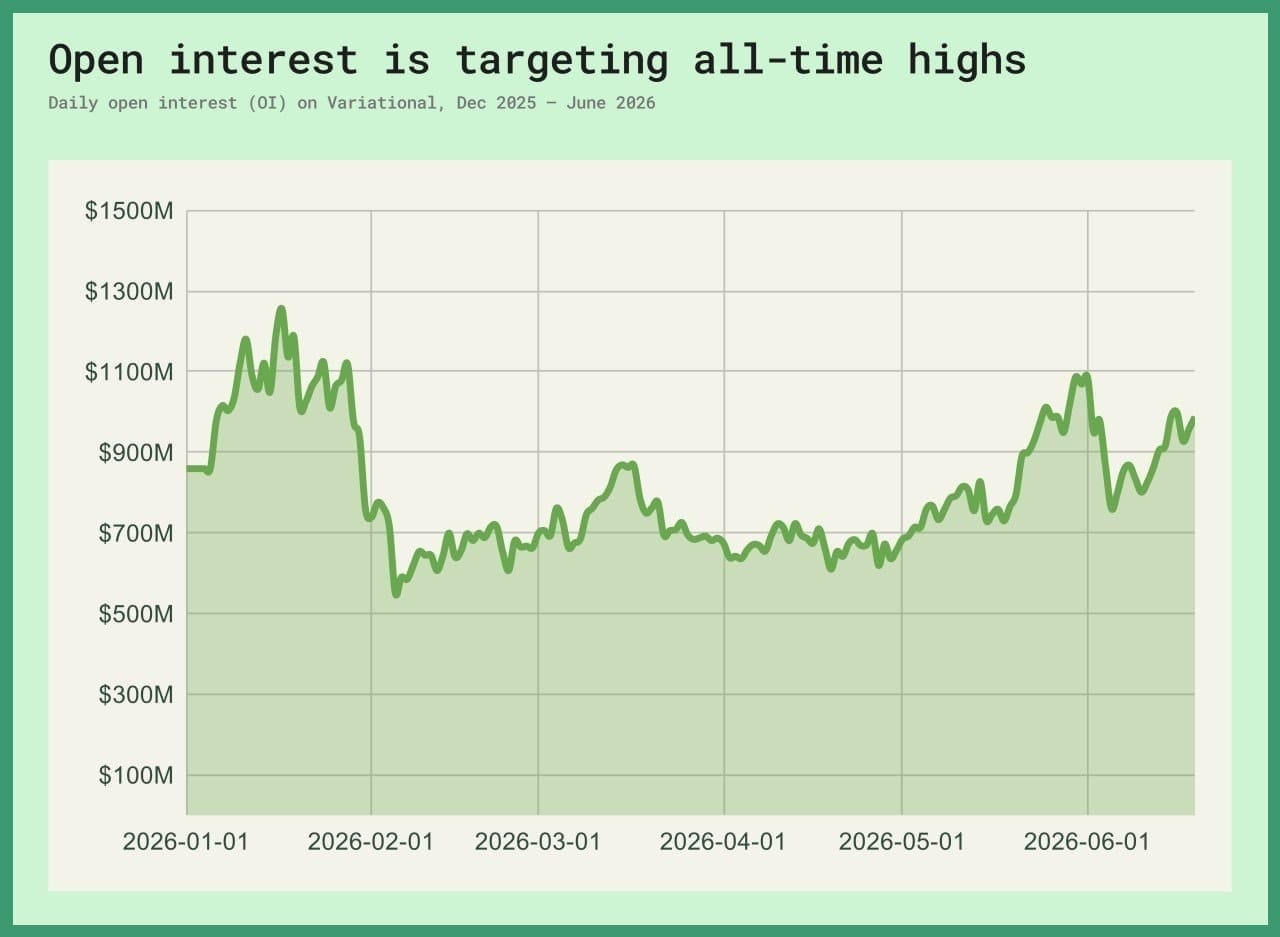
Weekly volume peaked above $10B in January before cooling off with the broader market, but activity has since picked up significantly. The same trend can be seen in open interest, which has recovered from the February lows and is now once again approaching previous highs.
RWA Traction
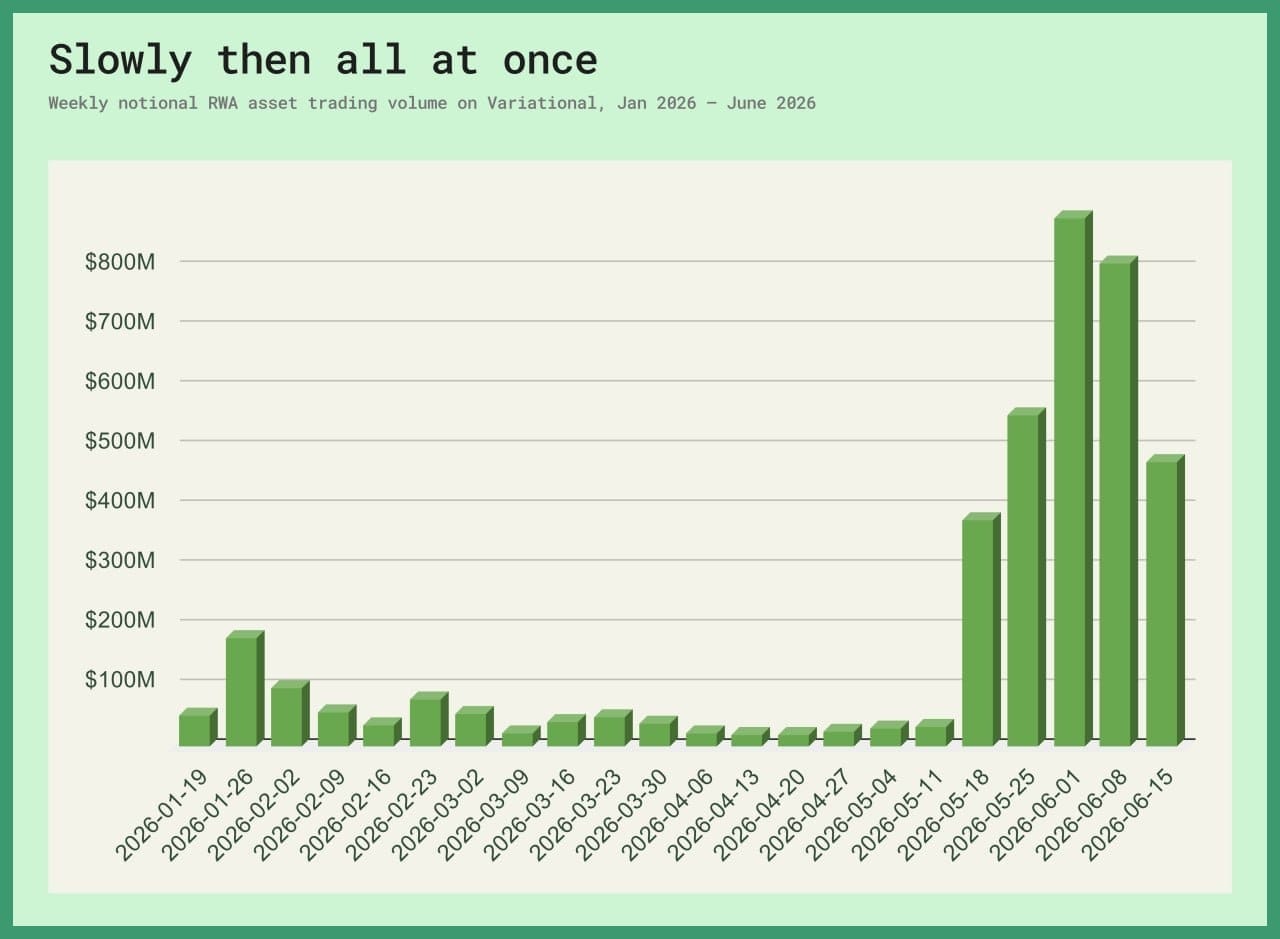
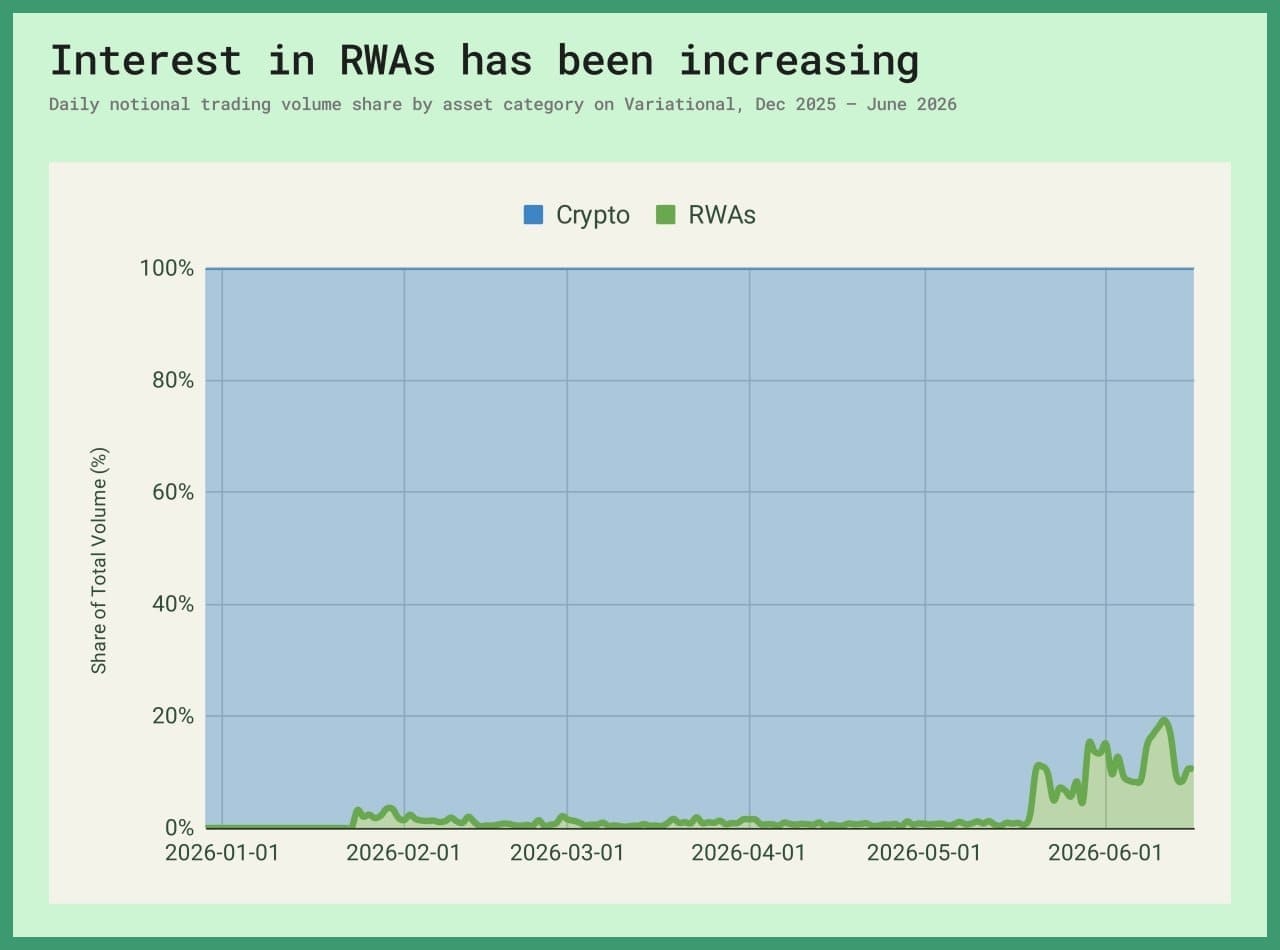
The more interesting part of the recent growth is the composition of that activity. Weekly RWA trading volume went from insignificant to hundreds of millions per week, peaking close to $900M in early June. At the same time, RWA volume market share has recently grown to 10-20% of daily volume on the exchange on most days.
For a venue built around liquidity aggregation, this is the main metric to watch. RWA perps are still early, but Variational is beginning to show that there is real demand outside of the usual BTC, ETH and SOL markets.
Get access to Variational here and receive a 12% boost to points earned
In the section below, you'll find our chat with Max from Variational.
Chat with Max from Variational
Why has Variational chosen to focus so heavily on RWA trading pairs and what are the benefits of using an RFQ/brokerage model rather than an orderbook design in this context?
"RWA perps have seen huge traction over the past two quarters, growing from near-zero volume to now being 10%+ of on-chain volume and open interest. As new crypto token launches have slowed and the industry consolidates, RWAs have become a far more interesting asset class for many on-chain traders. We simply want to offer what people want to trade, and people want to trade RWAs.
The main benefit of the RFQ/liquidity aggregation model in the context of RWAs is that it allows us to tap into existing liquidity on TradFi markets instead of fighting to rebuild it from scratch. Traditional finance has spent decades building the infrastructure and models to make RWA markets deeply liquid. Creating a new order book for each RWA market is attempting to compete with that liquidity; The Variational model connects directly to TradFi dealers and accesses all of that existing liquidity instead."
In short, how does Omni work and where is liquidity sourced currently? How will that change with Phase 2 and 3 of your RWA expansion?
"Omni operates by having the dedicated Omni Liquidity Provider (OLP) act as the counterparty to all trades. This liquidity provider connects to a variety of liquidity sources (CEXs, DEXs, OTC desks, TradFi dealers) to pass along aggregated liquidity to traders.
Currently, in Phase 1, OLP only connects to CEXs, DEXs, and OTC desks. In Phase 2, we will introduce the first TradFi dealer connections, enabling TradFi-grade execution during standard trading hours. Phase 3 will then focus on improving off-hours liquidity and exotic markets via specialized dealers."
Is the long tail of RWA and exotic markets set to go live on Variational where the volume actually is, or is it still BTC and ETH like most other exchanges, with the long tail as the differentiation story?
"We have seen significant traction on RWA markets already, which already account for approximately 15% of the protocol’s open interest. While BTC is still our largest market by OI and volume, we expect RWAs to follow a less top-heavy activity distribution than crypto."
How does the points program work? What user behavior are you trying to incentivize?
"The points program drops points weekly to active traders on Variational, and is designed to reward organic trading activity. It began in December 2025, and will run through Q3 2026."
How does Variational generate revenue by being the sole market maker on the exchange and what is the benefit of this design?
"By acting as the counterparty to all trades, the Omni Liquidity Provider is able to capture spread revenue that is leaked to third party market makers in traditional order book exchanges. This allows the protocol to generate revenue without charging any trading fees. On most platforms, users’ cost of trading is fees + spread. On Omni, the cost is isolated to just spread."
Variational is built as an application on Arbitrum. Are there any plans of spinning out as a separate application specific chain or rollup?
"Not currently. Arbitrum has served our technical needs well, and is still very widely used by traders within the crypto space. Arbitrum is also continually improving with tools and strategies to help abstract away the “crypto” feeling and move more towards fintech-style onboarding."
Your co-founder and CEO, Lucas Schuermann, has said he sees Variational as more "brokerage-like" than an exchange, and that with zero-fee trading, Robinhood is a better comparison than something like Hyperliquid. But that analogy only works if, like Robinhood, you bring in people who have never traded before. So who is the non-crypto-native Variational user, and what is the actual acquisition channel that reaches them?
"Lucas’ analogy focuses more on the platform design than the distribution model. The Robinhood comparison works well for two reasons: first since they are able to offer zero-fee trading because of the revenue generated through the spread, and second because they are not a price discovery venue/order book exchange, and rather aggregate liquidity from exchanges across a huge set of listings.
That being said, Variational is becoming an increasingly appealing platform for everyday traders, crypto-native or not. From 24/7 trading, to the simplicity of perps and the rapid settlement of stablecoins, we believe there are a variety of ways Variational improves over existing trading platforms even for traders who never touch a crypto market."
What's the story behind the name? Many projects in the space go for names that are short, punchy and memorable, whereas "Variational" leans the other way, more technical and abstract. As the growth person, was that ever a hard thing to build a consumer brand around, and how do you make it stick?
“Variational” is a term from statistics – I won’t pretend to be able to explain it. The story is that Variational did not begin as a consumer brand; it started as a market maker that was active on a variety of centralized and decentralized exchanges.
Having a complex name like Variational has its pros and cons from a growth perspective. It is very unique and stands out, despite being less obviously connected to the product. I have never felt like the name has held us back in our growth, and I believe there’s definitely precedent for consumer brands succeeding with technical or nondescript names: “Nvidia” comes to mind as an example."
Conclusion
The path forward for Variational is clear. The platform has already proven that it can attract meaningful volume and open interest through its crypto perps and the next area of growth lies in its RWA products.
If Variational can continue expanding the number of supported markets while improving execution and liquidity, RWAs could become the part of the platform that sets it apart from other perp DEXs. The demand is still early, but the recent growth suggests there is a real market for trading assets beyond the usual crypto majors on chain.